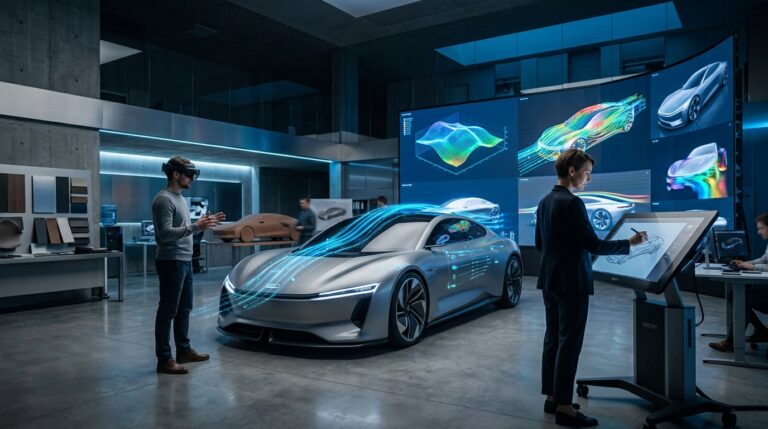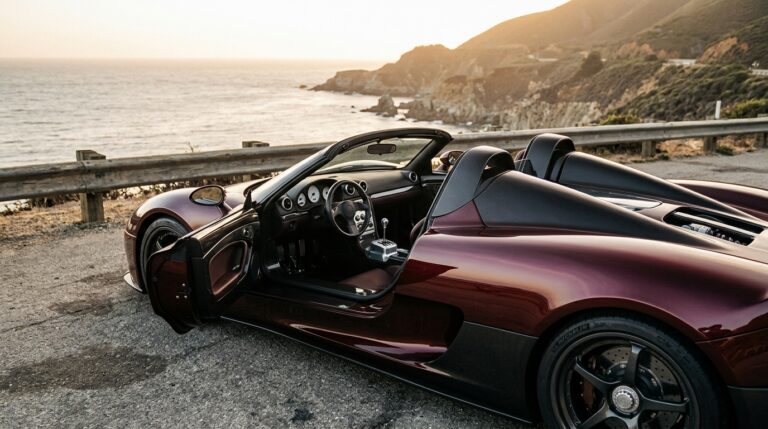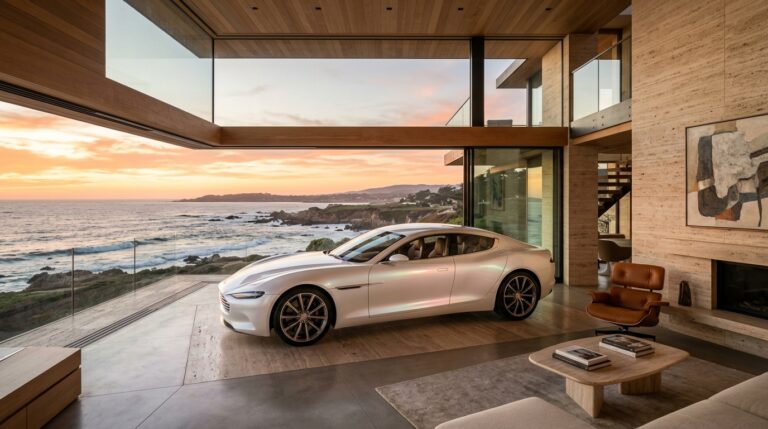
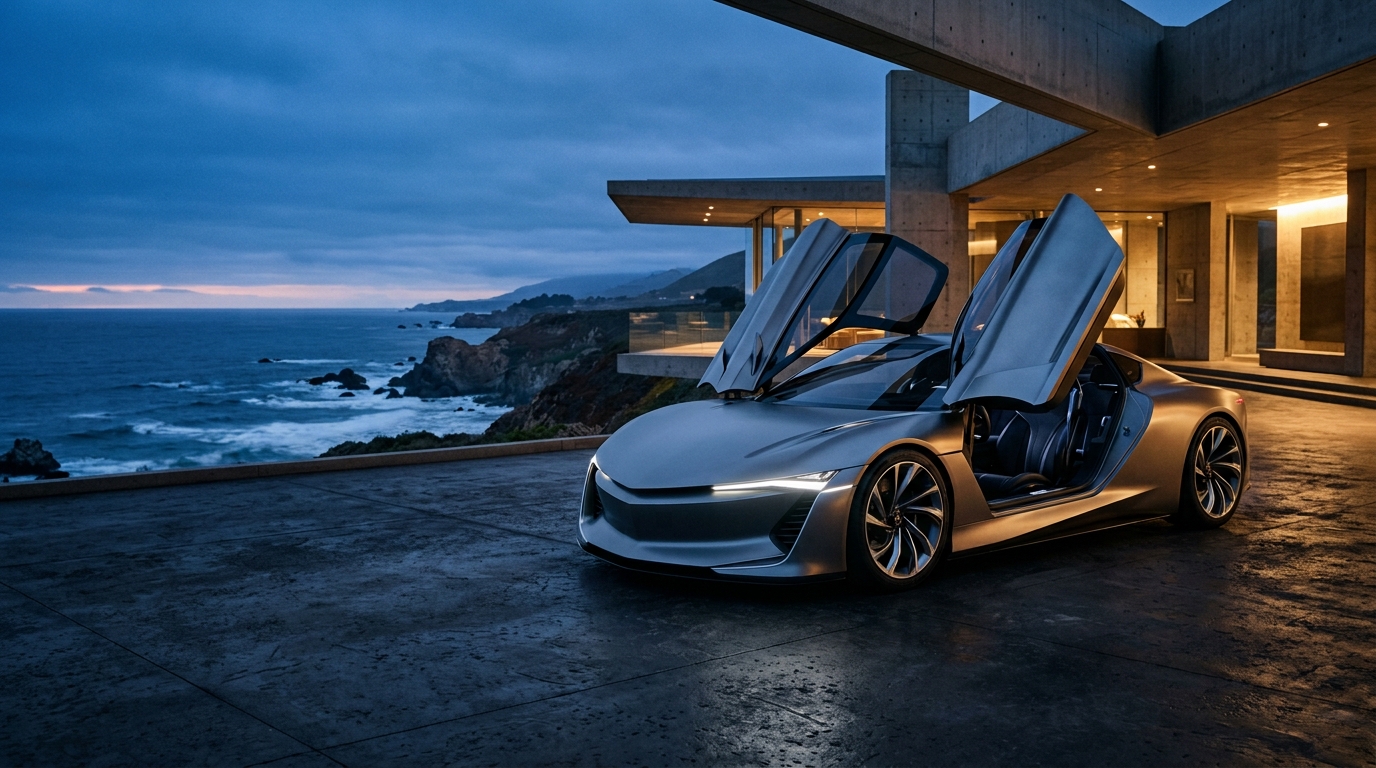
The Acura NEXERA Vision is not important because it promises a new production sports car. Its real significance is that Acura is using an extreme, low-slung concept to define the visual language of vehicles that will actually reach showrooms. Revealed during Monterey Car Week 2026 and displayed on the Pebble Beach Concept Lawn, the NEXERA Vision marks a deliberate reset for Acura design at the brand’s 40-year milestone.
Developed at Acura’s California design studio under Creative Director and Vice President of Auto Design Yasutake Tsuchida, the concept combines a long dash-to-axle proportion, a one-motion cabin, dual-hinge butterfly doors, active aerodynamic elements and a new lighting signature. Acura says those ideas will influence future production models, beginning with the fourth-generation RDX Hybrid expected in 2028.
The concept is less a preview of one vehicle than a concentrated statement of the cues Acura wants customers to recognize across different body styles. That connects directly with our Monterey Car Week 2026 automotive design trends coverage, where stronger brand identity emerged as a major theme. Like the BMW M Concept Neue Klasse, Acura is using proportion and lighting as core pieces of visual identity.
Why the Acura NEXERA Vision Matters More Than a Sports-Car Concept
Concept cars exaggerate the future, but the interesting question is which ideas are meant to survive production. With NEXERA, the answer starts with disciplined proportion and surface treatment: broad sculpted volumes, a wide and low stance and a cabin pushed rearward. The result looks fast before any specification is considered.
Proportion Is Becoming Acura’s First Layer of Brand Identity
Acura describes the NEXERA Vision as combining timeless beauty with high-tech details. That phrase matters because the concept is not trying to make every surface look digital. Its most powerful visual ideas are traditional ones: wheel placement, cabin position, body-to-glass relationships and the way the mass sits over the axles.
The Long Dash-to-Axle Ratio Creates Performance Before Technology Appears
One of the concept’s defining characteristics is its long dash-to-axle distance—the space between the center of the front wheel and the base of the windshield. Extending that dimension allows the cabin to sit farther rearward, creating the classic visual tension associated with front-engine grand tourers and performance cars even though a future production vehicle may use very different mechanical packaging.
Electrification and hybridization do not automatically require cab-forward, pod-like proportions. Acura instead suggests that future performance identity can still depend on stance. The one-motion cabin reinforces that idea, allowing windshield, roof and rear glass to read as one continuous aerodynamic gesture.
Butterfly Doors and Active Aero Turn Function Into Theater
The dual-hinge butterfly doors are among the concept’s most obvious show-car features, but they also reveal how Acura wants performance to feel. Their movement creates a moment of theater around entry and exit, turning the door into part of the vehicle’s experience rather than simply an opening panel.
Active aerodynamics perform a similar role. The exterior can alter its shape according to function, turning technology into physical movement rather than another screen. For readers exploring future mobility, that integration is an important design direction.
Phantom Lighting Could Become the Most Transferable NEXERA Design Idea
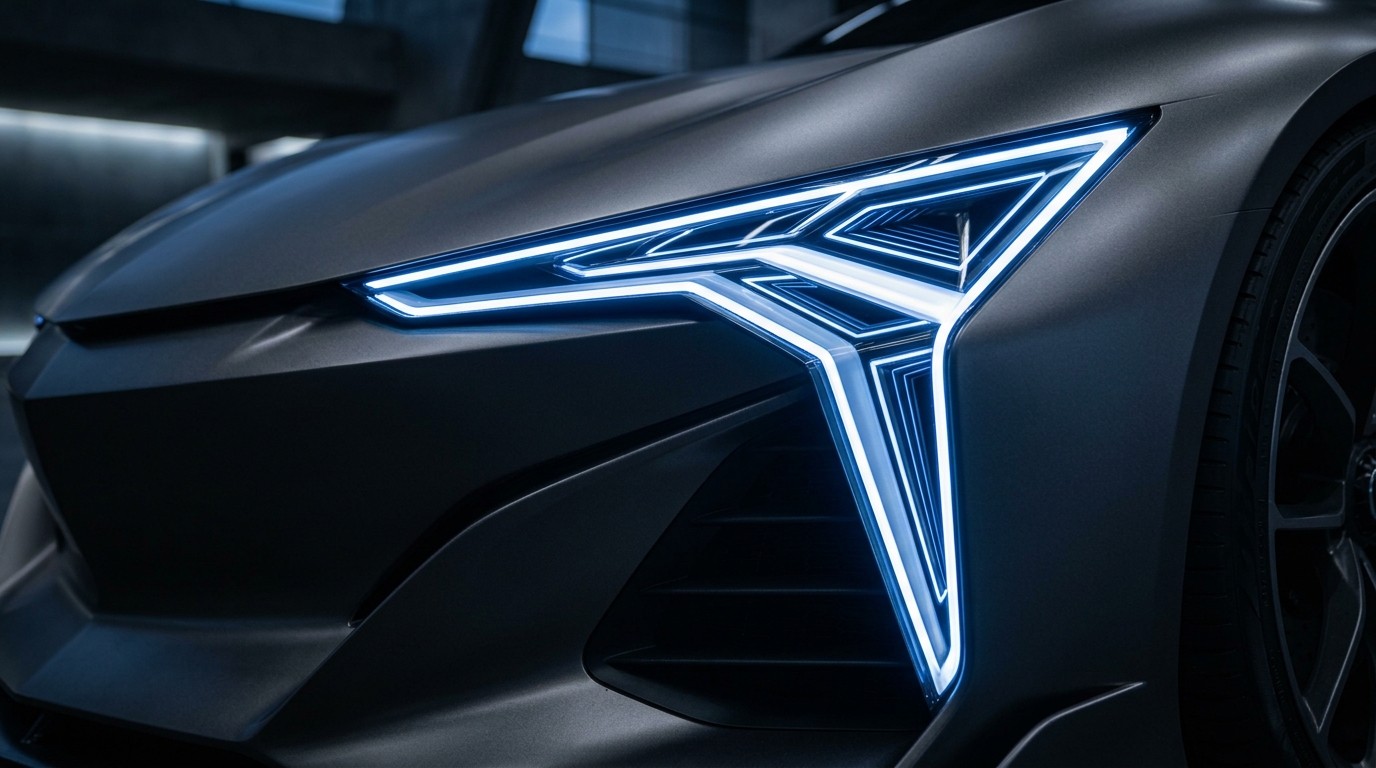
If the NEXERA Vision’s proportions establish its emotional foundation, the lighting system provides the clearest bridge to future production Acuras. The concept uses what Acura calls “phantom lighting”: lighting elements are concealed within the bodywork when switched off and appear only when illuminated.
The idea allows the body to remain visually clean in daylight because the lamps recede into the surface when they are not needed.
The Caliper A-Mark Becomes a Graphic Acura Can Use Across Different Vehicles
The ultrathin headlamps and taillamps take inspiration from Acura’s “Caliper A-mark,” turning the brand’s A motif into a lighting signature. This is significant because a lighting graphic can migrate from a sports-car concept to an SUV, sedan or other vehicle far more easily than a specific body shape.
Acura has already said the signature will begin appearing on future production designs with the next-generation RDX Hybrid. That makes lighting one of the clearest examples of concept-car thinking moving directly toward the road.
As electrified vehicles use less traditional grille area, lighting becomes a stronger tool for recognition. Like architecture at night, it can define edges, depth and rhythm. NEXERA is effective because the lamps support the body’s surface logic: hidden when off, graphic when illuminated.
What the NEXERA Vision Could Mean for Future Production Acuras
The real test is translation. A dramatic concept has fewer constraints than a compact luxury crossover, which must satisfy packaging, visibility, cargo, safety and manufacturing requirements. Acura’s confirmation that the fourth-generation RDX Hybrid will be the first production model influenced by NEXERA therefore makes the concept more consequential.
The RDX Hybrid Will Test Whether the Design Language Scales
The next RDX is expected to introduce Acura’s first two-motor hybrid application and arrive in 2028. It will occupy a very different architectural category from the NEXERA Vision, but Acura has explicitly linked the concept’s lighting signature and broader design direction to that vehicle.
That connection suggests Acura is thinking in systems rather than copying individual features. A successful family identity needs principles that can adapt to different uses.
From Low Sports Car to Crossover, the Real Test Is Discipline
Translating the NEXERA Vision into an RDX-sized crossover will probably mean preserving graphic clarity rather than literal sports-car proportion. The long dash-to-axle relationship may be moderated, the butterfly doors will not define a mainstream utility vehicle, and active aerodynamic elements may take subtler forms. But a strong stance, controlled surfacing, one-motion upper-body logic and concealed lighting can all influence a practical production design.
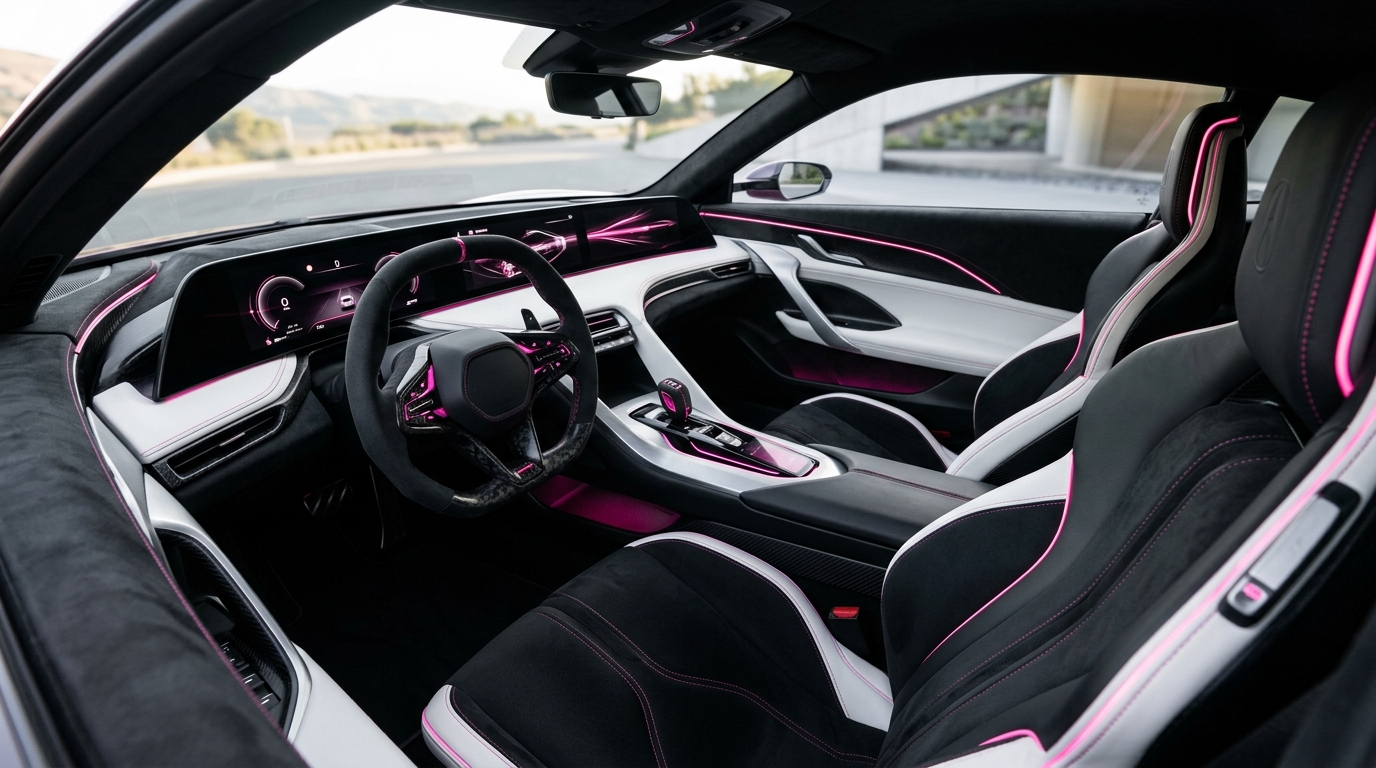
The interior provides another clue. Acura describes the NEXERA cabin as balancing spaciousness with a precision-focused feeling. Its black-and-white base is punctuated by vivid pink accents, while sustainable materials include recycled-polyester Alcantara, CircuLeather and recycled aluminum. Pebble Beach also highlights forged carbon as part of the concept’s material strategy.
Those choices align with themes across automotive design studios: premium interiors are increasingly judged by material intelligence and visual editing rather than sheer quantity of technology.
Another reason the concept matters is timing. Acura is entering its fifth decade while the luxury market is being reshaped by hybridization, software-heavy cabins and increasingly similar aerodynamic requirements. In that environment, a brand cannot rely on technology alone to feel distinctive. The same battery chemistry, sensors or screen suppliers can appear across many vehicles. What buyers remember is how those technologies are organized into a coherent visual and tactile experience.
NEXERA’s answer is to make advanced systems less visually intrusive. The lighting disappears into the body, sustainable materials are used as premium surfaces rather than environmental decoration, and the cabin uses contrast to create focus. That approach is relevant beyond Acura because it suggests a more mature phase of high-tech design: innovation does not always need to announce itself loudly. Sometimes the most sophisticated technology is the technology that lets the form stay clear.
The NEXERA Vision
The NEXERA Vision therefore offers a useful view of Acura’s priorities at a transitional moment. Rather than choosing between emotional performance design and advanced technology, the brand is trying to combine the two. Proportion provides the emotion. Lighting provides recognition. Sustainable materials update the meaning of premium. Active systems allow the physical design to respond to function.
Future Acuras should not look as dramatic as NEXERA. What matters is whether the principles survive after the spectacle is removed. The next RDX Hybrid should feel related without becoming a diluted concept car—that is the harder design achievement.
The concept also reinforces a larger lesson for the industry in 2026. As hybrid and electric technologies spread across brands, the powertrain itself becomes less useful as visual differentiation. Automotive identity will increasingly come from proportion, surface quality, lighting, materials, interface and the relationship between technology and physical form.
For Acura, NEXERA is therefore less about predicting one future model and more about establishing a visual grammar for the next generation. The first real evidence will arrive when its design principles appear on the road.
For official information about the concept, its lighting system, sustainable materials and its connection to the next-generation RDX, see the official Acura NEXERA Vision overview.